CED Systems · Dashboards for roofing company owners
Roofing money moves from storm to cash in a dozen steps. Here are 7 reasons you can't see most of them.
A roof is sold, produced, supplemented, invoiced, and collected across weeks and half a dozen hands. Owners typically see the endpoints — jobs sold, money in — and guess at everything between. These dashboards make the middle visible.
See a built view, live — the Storm-to-Cash Clock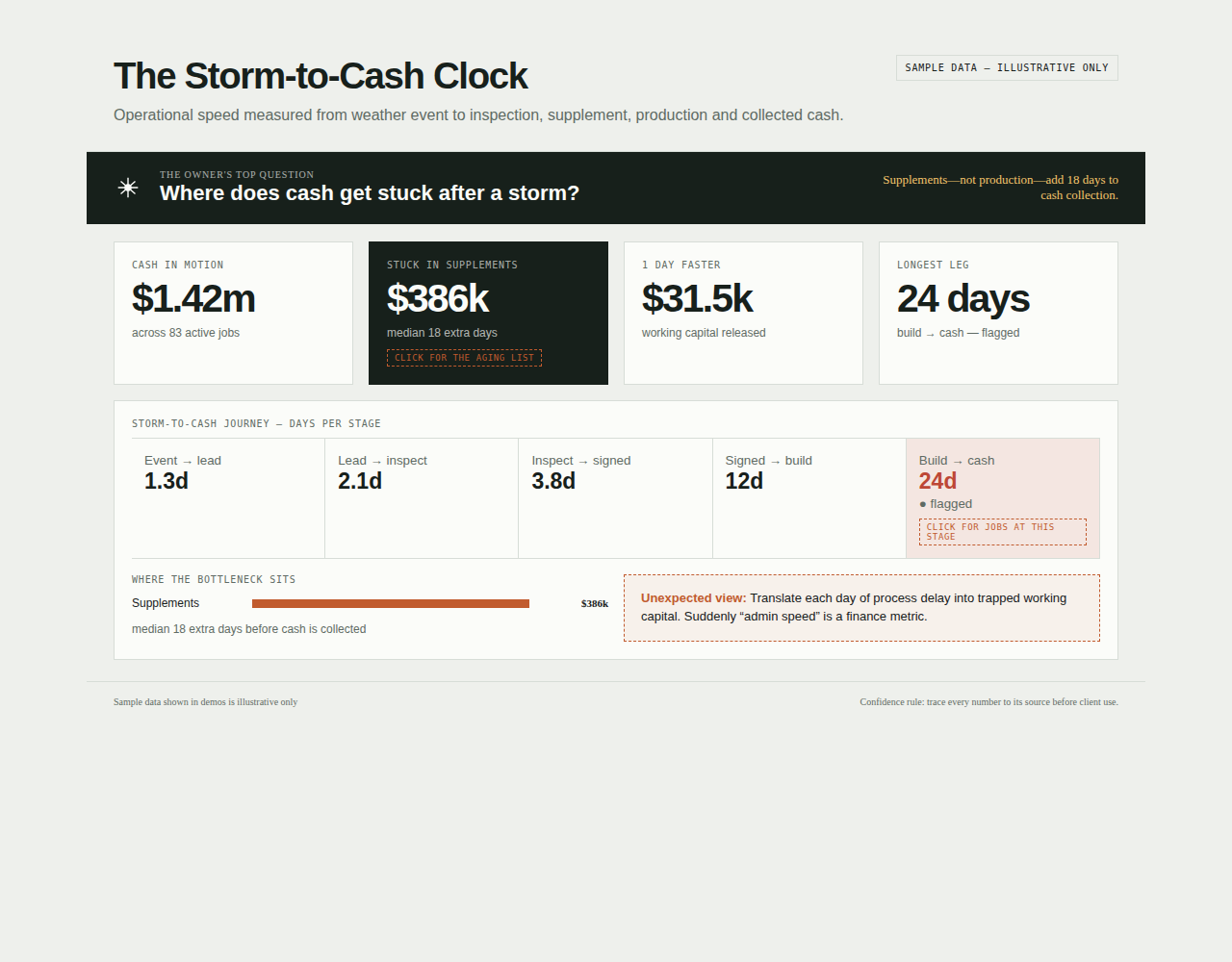
One of the built views, working: the Storm-to-Cash Clock — shown with sample data, labeled as sample data. The demo is the real build, not a mockup.
Call (864) 999-4430 — see my roofing dashboard Email for a walkthroughSee it with sample data first, in a short walkthrough. Then we talk about connecting yours.
The roofing collection
- Storm-to-Cash Clock — every job's elapsed time at each stage from storm/sale to collected — where jobs stall
- Crew Promise Board — what was promised to the homeowner vs. what happened, by crew and by date
- Neighborhood Echo — one roof in a neighborhood should become three: where your jobs are echoing, and where they aren't
- Carrier Scorecard — insurance carriers scored on cycle time and supplement outcomes — know who you're really working with
Every view answers one money question. Stack views together and they cross-filter — click one number and the rest of the board answers for that slice of your business.
7 reasons to run your company on a board instead of reports
Reason 1 · The stall is the cost
Jobs don't die; they sit
A job stalled at supplement review or waiting on a material order is cash locked in a wall. The Storm-to-Cash Clock times every stage per job, so the stall — and who can unstick it — is visible at a glance.
Reason 2 · Promises are your reviews
Kept dates are a system, not a hope
Homeowners forgive weather; they don't forgive silence. The Crew Promise Board compares every promised date and update against reality, per crew — the earliest warning you'll ever get of a reputation problem.
Reason 3 · Echo or silence
A finished roof is a billboard that expires
The weeks after a build are when neighbors call. Neighborhood Echo maps where completed jobs produced nearby work and where they produced none — so canvassing goes where it has already worked.
Reason 4 · Not a generic report
Built for your trade, not adapted to it
Generic BI tools show you charts of whatever you feed them. These views were designed around the decisions roofing owners actually make — the money questions are baked in, not configured later by you.
Reason 5 · Reconciles or it doesn't ship
Every number ties back to your source
A dashboard you can't trust is worse than none. Each headline figure reconciles to the underlying records, and you can drill from the headline down to the individual job behind it.
Reason 6 · Already built
You see the real thing, not a mockup
This collection exists — built, working, walkthrough-ready with sample data, clearly labeled as sample data. You're not funding a prototype; you're connecting a finished instrument to your business.
Reason 7 · A weekly rhythm
One board, one short weekly meeting
The board is built for a weekly rhythm: what made money, what leaked, what gets decided this week — the same questions, answered from the same reconciled numbers, every Monday.
How it works
- See it first. Walk through the built dashboard with sample data — the exact views, working — before you commit to anything.
- Connect your data. We connect the dashboard to the systems you already run and map your fields to the views. Every headline number reconciles back to your source.
- Run on it weekly. A Monday-morning board: what made money, what leaked, what needs a decision. We support the dashboard and its functions — your data entry and accuracy stay yours, as they should.
The objections we hear
“We run a CRM for jobs already.”
The CRM tracks jobs one at a time. These views score the system across jobs — stage times, promise-keeping, carrier behavior, neighborhood yield — the patterns no single job record shows.
“Insurance work is too messy for a dashboard.”
It's exactly messy enough to need one. The Carrier Scorecard exists because cycle time and supplement outcomes vary by carrier and adjuster patterns repeat — owners who can see the pattern negotiate and plan cash flow differently.
“What does it cost?”
Set on the call, after the walkthrough. Call (864) 999-4430.