CED Systems · Dashboards for cities & counties
Your budget is public. Here are 7 reasons almost nobody can read it.
Budgets and audits are published as hundreds of pages of PDF. Council members, staff, and citizens all deserve the same numbers in a form that answers questions: Are we on budget? Which fund is drifting? Where does the money come from, and where did it go? These dashboards are built entirely from your own published documents.
See the live example — a real city's published numbers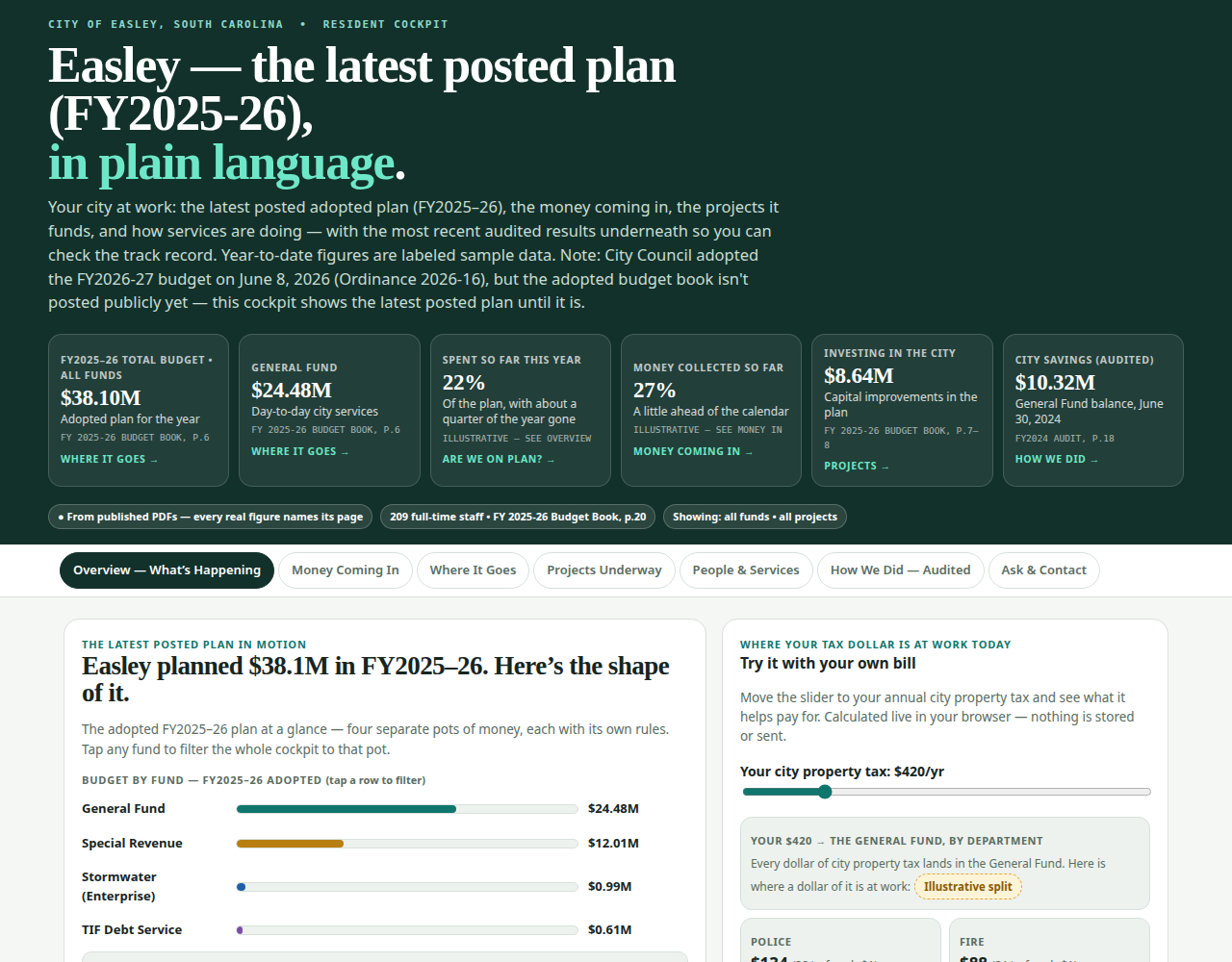
A working example, built entirely from the City of Easley's published budget and audited financials — public documents, labeled as such. The demo is the real build, not a mockup.
Call (864) 999-4430 — see my local government dashboard Email for a walkthroughSee it with sample data first, in a short walkthrough. Then we talk about connecting yours.
The local government collection
- Spending vs. Budget — actuals against adopted budget by department and fund, through the year — variance with a face
- Revenue by Source — where the money comes from, trended — taxes, fees, grants, and how the mix is shifting
- Audit View — built from audited financial statements: the verified picture, fund by fund, year over year
Every view answers one money question. Stack views together and they cross-filter — click one number and the rest of the board answers for that slice of your business.
7 reasons to put the public's numbers on a board instead of in PDFs
Reason 1 · Public ≠ readable
A 400-page PDF is disclosure, not transparency
Publishing the budget satisfies the law. It does not give a council member in a Tuesday meeting — or a citizen at home — an answer. A dashboard turns the same official numbers into the questions people actually ask, answered in seconds.
Reason 2 · Variance early
A fund drifting in March is a conversation; in October it's a problem
Spending vs. budget by department and fund, tracked through the year, surfaces drift while it's still a management decision instead of a year-end surprise in the audit.
Reason 3 · One set of numbers
Council, staff, and public — same source, same figures
Every figure is built from the entity's own published budget and audited financials — public documents, labeled as such. When everyone argues from the same verified numbers, the meeting is about decisions, not dueling spreadsheets.
Reason 4 · Your documents, your story
Built from published budgets and audited financials only
No internal systems, no estimates, no outside data dressed up as yours. The example build uses a real city's published FY2026 budget and FY2023 audited financials, labeled as public documents throughout.
Reason 5 · Questions councils ask
Department? Fund? Year? One click
Cross-filtering means the follow-up question doesn't need a staff report next month. Filter by department, fund, or year and every view re-answers from the same reconciled source.
Reason 6 · Reconciles to the document
Every number ties to a page in your published record
Trust is the whole product. Each figure on the board reconciles back to the adopted budget or audited statements it came from — the drill-down ends at your document, not at our say-so.
Reason 7 · Already built
See a working example before any commitment
The local government collection is built and walkthrough-ready with a real published example. You see exactly what a resident or a council member would see — before your entity spends anything.
How it works
- See it first. Walk through the built dashboard with sample data — the exact views, working — before you commit to anything.
- Connect your data. We connect the dashboard to the systems you already run and map your fields to the views. Every headline number reconciles back to your source.
- Run on it weekly. A Monday-morning board: what made money, what leaked, what needs a decision. We support the dashboard and its functions — your data entry and accuracy stay yours, as they should.
The objections we hear
“We already publish our budget online.”
Publishing is the first step; this is the second. The dashboard makes the published numbers answer questions interactively — by department, fund, and year — for people who will never open a 400-page PDF.
“Does this require our internal systems or data?”
No. The dashboards are built from published budgets and audited financial statements. Nothing internal is accessed, and every figure is traceable to the public document.
“What does it cost?”
Scoped to the entity's size and documents, and set on the call after the walkthrough. Call (864) 999-4430 or email dashboards@cedservice.com.