CED Systems · Dashboards for dental practice owners
There's a bank sitting in your charts. Here are 7 reasons your reports never show it.
Every diagnosed-but-unscheduled treatment plan in your system is money already earned clinically and never collected operationally. Most practices couldn't state the total within a very wide margin. These dashboards exist to state it — and to grade the schedule and the trust funnel that feeds it.
See a built view, live — the Unfinished Treatment Bank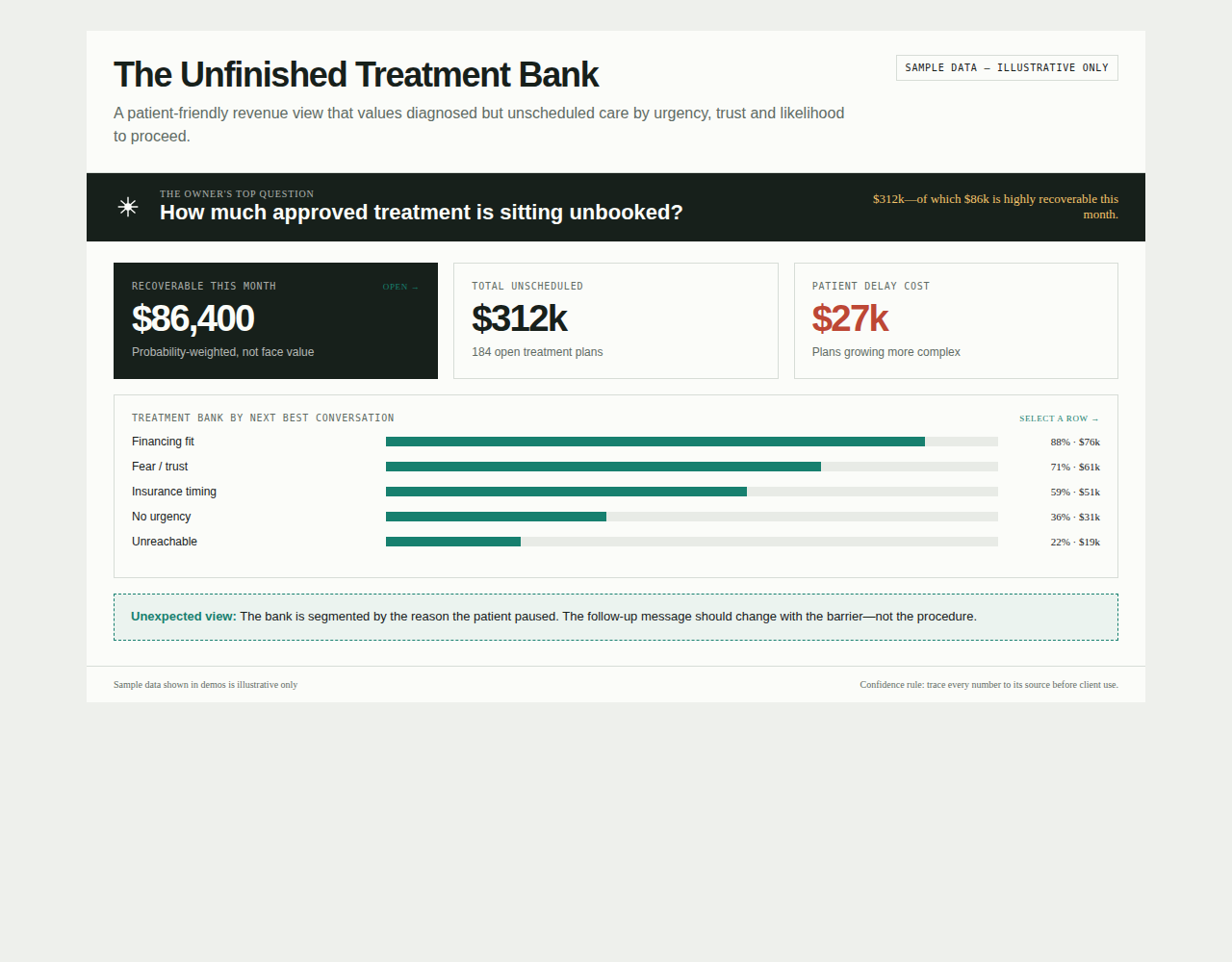
One of the built views, working: the Unfinished Treatment Bank — shown with sample data, labeled as sample data. The demo is the real build, not a mockup.
Call (864) 999-4430 — see my dental dashboard Email for a walkthroughSee it with sample data first, in a short walkthrough. Then we talk about connecting yours.
The dental collection
- Unfinished Treatment Bank — every diagnosed, unscheduled treatment plan, valued and aged — your largest hidden asset
- Schedule Quality Score — the week ahead graded: gaps, overloads, hygiene re-care holes, no-show risk
- Patient Trust Funnel — exam → diagnosis → acceptance → scheduled: where patients say yes and where they quietly don't
Every view answers one money question. Stack views together and they cross-filter — click one number and the rest of the board answers for that slice of your business.
7 reasons to run your practice on a board instead of reports
Reason 1 · The hidden bank
Diagnosed is not scheduled, and unscheduled evaporates
Treatment diagnosed and not scheduled decays fast — patients forget, move, or get it done elsewhere. The bank view values and ages every open plan, so follow-up works the biggest, freshest value first instead of whoever happens to answer.
Reason 2 · Schedule quality, graded
A full schedule can still be a bad schedule
Back-to-back overloads, dead gaps, and hygiene holes hide inside a 'full' week. A single quality score per day tells the front desk where to defend, where to fill, and where the no-show risk is concentrating.
Reason 3 · Acceptance is a funnel
Patients don't say no — they stall at a stage
Exam, diagnosis, acceptance, scheduling: each conversion is measurable, per provider. The Trust Funnel shows which stage leaks for whom, turning 'we need more new patients' into a specific, fixable step.
Reason 4 · Not a generic report
Built for your trade, not adapted to it
Generic BI tools show you charts of whatever you feed them. These views were designed around the decisions practice owners actually make — the money questions are baked in, not configured later by you.
Reason 5 · Reconciles or it doesn't ship
Every number ties back to your source
A dashboard you can't trust is worse than none. Each headline figure reconciles to the underlying records, and you can drill from the headline down to the individual patient behind it.
Reason 6 · Already built
You see the real thing, not a mockup
This collection exists — built, working, walkthrough-ready with sample data, clearly labeled as sample data. You're not funding a prototype; you're connecting a finished instrument to your business.
Reason 7 · A weekly rhythm
One board, one short weekly meeting
The board is built for a weekly rhythm: what made money, what leaked, what gets decided this week — the same questions, answered from the same reconciled numbers, every Monday.
How it works
- See it first. Walk through the built dashboard with sample data — the exact views, working — before you commit to anything.
- Connect your data. We connect the dashboard to the systems you already run and map your fields to the views. Every headline number reconciles back to your source.
- Run on it weekly. A Monday-morning board: what made money, what leaked, what needs a decision. We support the dashboard and its functions — your data entry and accuracy stay yours, as they should.
The objections we hear
“We track treatment plans already.”
Tracking lists them. The bank values, ages, and prioritizes them like the asset they are — total dollars, dollars by age band, dollars by provider — so recall work starts where the money is.
“Will this shame my providers?”
It's an owner's instrument, not a scoreboard. The point is pattern-finding — which stage leaks, which day grades poorly — so coaching and scheduling fix the system, not blame a person.
“What does it cost?”
Set on the call, after you've walked through the built views with sample data. Call (864) 999-4430.